Nectarine ‘Button Bright’
Nectarine
Nectarine ‘Button Bright’ is a smooth-skinned stone fruit cultivar developed by the Institut National de la Recherche Agronomique (INRA) in France, registered under Plant Variety Rights number 3115. As a nectarine, it belongs to Prunus persica, a species native to China with a long history of cultivation across temperate regions worldwide. What sets Nectarine ‘Button Bright’ apart is its combination of reliable self-fertility, attractive ornamental blossom, and consistent cropping of sweet, flavourful fruit — qualities that suit both the home orchardist and the productive garden alike.
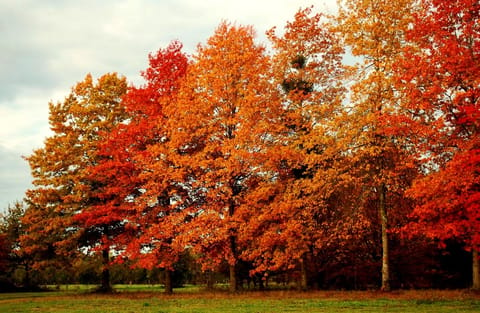
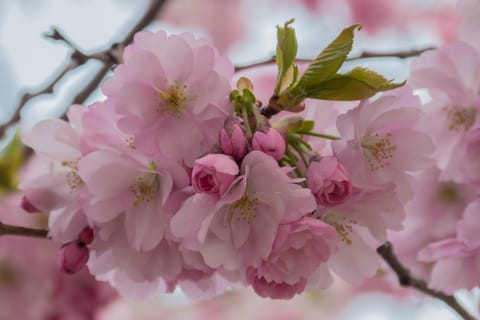
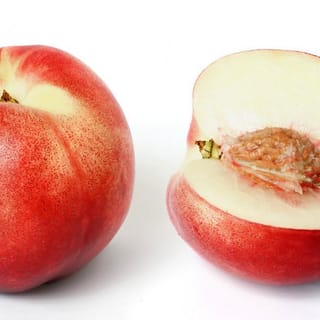
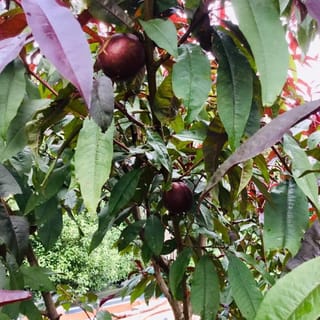
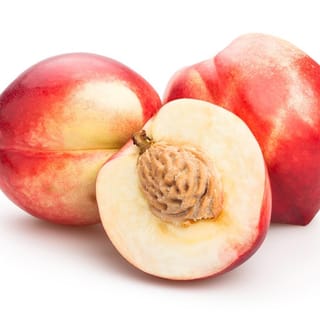
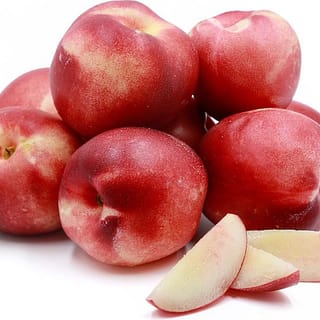
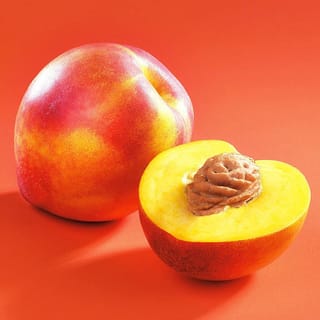
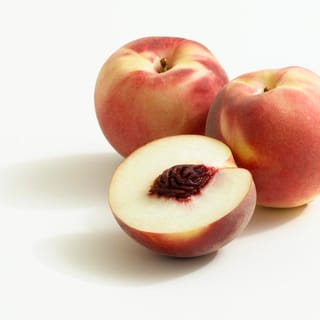
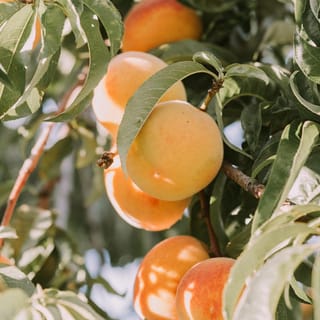
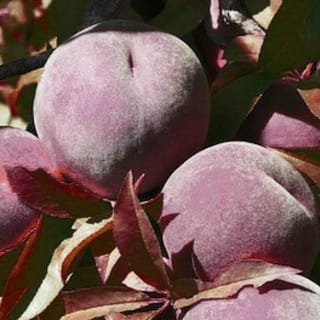
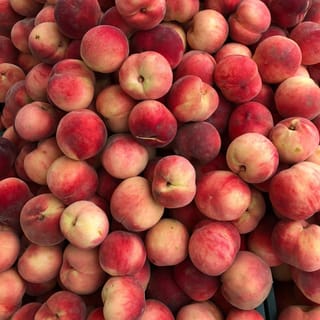
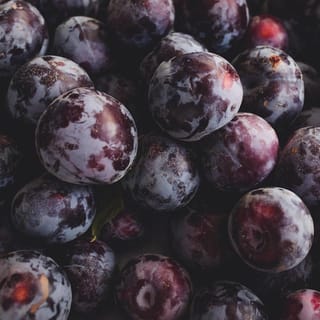
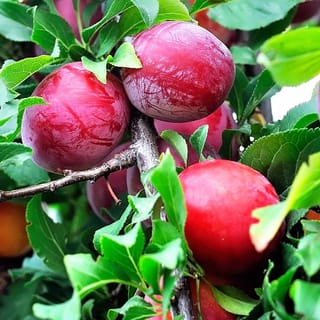
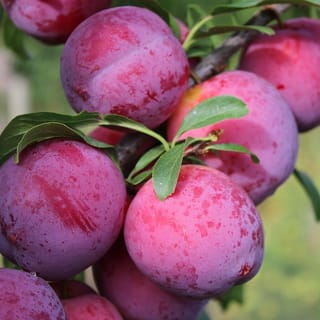
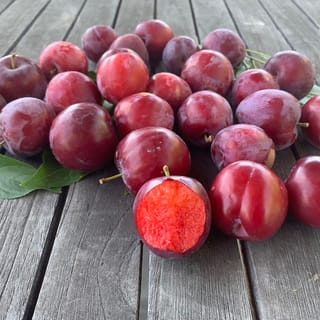
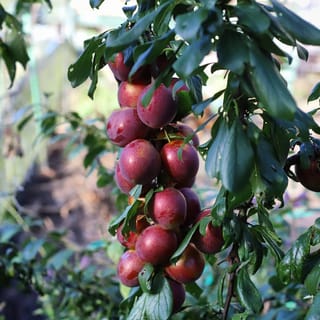
Nectarine ‘Button Bright’ follows the characteristic seasonal rhythm of deciduous stone fruits. In spring, a generous display of pink blossoms emerges before the foliage, providing early ornamental interest and signalling the beginning of the growing season. Through summer, the tree carries mid-green, lance-shaped foliage typical of the nectarine family. In autumn, the leaves transition to warm yellow tones before the tree enters winter dormancy. The fruit is the centrepiece: red-skinned nectarines with sweet yellow flesh that ripen through mid to late summer and are produced in reliably good quantities each season.
Nectarine ‘Button Bright’ performs well across a wide range of New Zealand growing conditions, particularly in regions with warm, dry summers and distinct winters — the conditions that encourage strong fruit set and flavour development. It requires a position in full sun with good air circulation and a well-drained soil; heavy or persistently wet soils should be avoided. Although Nectarine ‘Button Bright’ benefits from consistent irrigation as its fruit develops, it shows solid drought tolerance once established, making it a sound choice as New Zealand’s climate becomes increasingly variable. Its self-fertile habit means it crops well as a single specimen, without the need for a companion pollinator.
Nectarine ‘Button Bright’ is well suited to home orchards, kitchen gardens, and edible landscapes where seasonal interest and productive value are both priorities. It can be grown as a free-standing specimen, trained against a warm, sheltered wall to maximise sun exposure, or incorporated into mixed planting schemes that celebrate the ornamental qualities of fruiting trees. The succession of spring blossom, summer harvest, and autumn foliage colour ensures genuine year-round appeal. It is particularly recommended for warmer New Zealand regions, including Hamilton and the Waikato, where long, warm summers allow the fruit to ripen fully and develop its characteristic sweetness.
- Prunus persica var. nectarina 'Button Bright'
- Nectarine 'Oriola'
- Prunus persica var. nectarina 'Oriola'
Order Nectarine ‘Button Bright’ (Nectarine)
Standard height is the height of the clear trunk before the graft and branching begins. Low worked (LW) trees are grafted or allowed to branch much lower on the trunk. Clear trunk (CT) vs Bushy is the difference between trimming branches up and allowing them to grow out from lower down on the trunk. Cloud pruned trees have foliage that is shaped into distinct, rounded “clouds” on carefully spaced branches.
Out of stock
If you are interested in this plant please get in touch with us at [email protected]
There may be stock not listed here that we can supply.
More information about Nectarine ‘Button Bright’ (Nectarine)
Deciduous
Resilient
See below for an explanation of terms.
Summer
Autumn
Winter
Spring
Explanation of terms
This scale provides information on the resilience of species to the projected future climate in New Zealand – using the Auckland Botanic Gardens as the central location for projected future temperatures. This projection is based upon the ‘Business as Usual’ climate change scenario that uses the SSP3 or RCP7.0 emission scenario as laid out by the IPCC. It is a ‘worst case scenario’ and predicts the climate of 2090 — 70 years into the future — assuming that no steps have been taken to curb global emissions. The analysis of climate suitability of species is based on Mean Annual Temperature (MAT). The MAT for the Auckland Botanic Gardens under the ‘Business as Usual’ climate change scenario is projected to be 18.8 °C.
Highly resilient indicates that the species is mostly found growing within this MAT, meaning that at this MAT the species is expected to be within its preferred temperature range. Bear in mind that the MAT does not necessarily account for extreme weather events, such as heatwaves or frosts/freezes, and droughts. A species’ precipitation needs should be considered as well.
Resilient indicates that the species does occur at this temperature. It may not be the species’ most preferred climate, but it is anticipated to be well suited to this MAT.
Limited resilience indicates that there are known occurrences of the species growing at this MAT, but this MAT is near the limit of known occurrences. The species may be able to be grown at this temperature, but care regarding its microclimate, context and vulnerability to other factors such as pests and diseases may be required.
Not currently recorded indicates that there are no current records of the species growing at this MAT. If there are very few records for a specific species, this may simply be an indication of a lack of recorded observations, and not plant performance.
It is important to note that there are, generally speaking, more records occurring in the Northern Hemisphere and in cooler climates than there are for the Southern Hemisphere and the southern predominance of warmer climates. This can lead to a potential skewing in the data and results may be biased toward colder climates, indicating less heat tolerance than is true of the species.
This information gleaned from the Climate Assessment Tool aims to provide guidance and support for decisions; it is not an absolute answer, and while the predictions are based on rigorous scientific data, they are just that — predictions. The information will give you an idea of what is more likely to suit New Zealand’s future climate, but trialling of plants in the landscape is still a necessity.
Information sourced from the Climate Assessment Tool provided by the Botanic Gardens Conservation International organisation and can be accessed here: https://cat.bgci.org

Healthy crowns differ in their density as a function of leaf and branching characteristics. Three categories are used: dense, moderately dense and open. In some cases, it has been possible to underpin these categories with leaf area index (LAI: leaf area per unit ground area (m2 m-2) data.
Dense crowns typically have a LAI of >6m2 m-2.
Moderately dense crowns typically have a LAI of 3-6m2 m-2.
Open crowns typically have a LAI of <3m2 m-2.
Information sourced from the Tree Species Selection for Green Infrastructure guide produced by the Trees & Design Action Group. Find the guide here: https://www.tdag.org.uk/tree-species-selection-for-green-infrastructure.html
Tree crowns often have a characteristic form when grown in open environments. This feature can often be an important design element of a planting scheme as well as affecting how the tree crown interacts with surrounding vegetation and infrastructure. Despite a tendency for a particular form, very few species rigidly conform to a particular shape. Many species are inherently variable in their morphology as a function of maturity or environment and fall somewhere between categories.
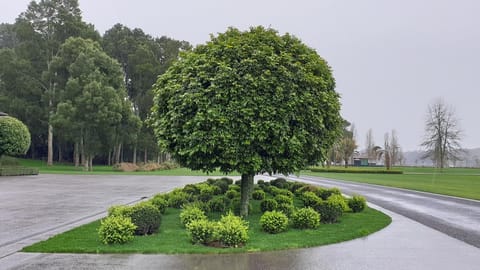
Globular crowns have a rounded form with vertical and horizontal dimensions being approximately equal.
Ovoid crowns are somewhat elliptic, broader at the base than they are at the top, with the vertical axis greatly exceeding the horizontal axis.
Obovoid crowns are also somewhat elliptic, with the vertical axis greatly exceeding the horizontal axis but are broader in the upper part of the crown.
Conical crowns are approximately triangular in their outline and are broadest at their base.
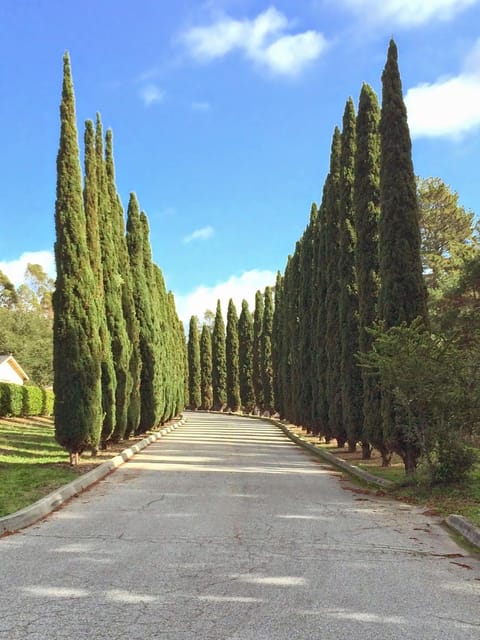
Columnar crowns have a vertical axis that greatly exceeds the horizontal axis but the proportions of the upper and lower crown are similar.
Irregular crowns have an asymmetrical and uneven outline.
Weeping crowns have strongly pendulous branches.
Vase crowns are much broader in the upper crown, which is often relatively flat rather than rounded.
Information sourced from the Tree Species Selection for Green Infrastructure guide produced by the Trees & Design Action Group. Find the guide here: https://www.tdag.org.uk/tree-species-selection-for-green-infrastructure.html
The four-level scale, tolerant, moderately tolerant, moderately sensitive and sensitive, makes use of a number of sources of information (see the guide below for further information on this).
Regardless of a species’ drought tolerance ranking, the full expression of drought tolerance will only come about in well-established trees. Therefore, the selection of drought tolerant trees should never be seen as a substitute for good post-planting aftercare, such as mulching and irrigation.
Tolerant
Moderately tolerant
Moderately sensitive
Sensitive
Information sourced from the Tree Species Selection for Green Infrastructure guide produced by the Trees & Design Action Group. Find the guide here: https://www.tdag.org.uk/tree-species-selection-for-green-infrastructure.html
Evergreen plants retain foliage year-round but still shed and replace some leaves gradually as part of their normal growth cycle, rather than losing them all at once.
Deciduous plants shed all their leaves for part of the year (usually in autumn and winter), usually in response to colder temperatures or dry seasons, often producing seasonal colour before leaf drop.
Semi-evergreen plants sit between the two, keeping most of their foliage but losing some or all leaves briefly under cooler or drier conditions before quickly regrowing them.
A species is allocated its shade tolerance rating based on whether they can grow satisfactorily at a certain light availability. The four-level scale used relates approximately to the following light conditions, expressed as a percentage of full sunlight.
Tolerant (<10% full sunlight)
Moderately tolerant (10-25% full sunlight)
Partially tolerant (25-50% full sunlight)
Intolerant (>50% full sunlight)
It should be noted that many species towards the more tolerant end of the spectrum often perform better in slightly higher light levels than their tolerance rating suggests, however, it is generally unrewarding to plant moderately tolerant or tolerant trees in fully open (high-light) environments. It should also be acknowledged that, for many larger species, shade tolerance diminishes somewhat with age. This is because a tree’s need for shade tolerance is typically reduced as it becomes established within the forest canopy. Therefore, the allocated ratings are most closely related to young trees of the species and not fully mature specimens.
Information sourced from the Tree Species Selection for Green Infrastructure guide produced by the Trees & Design Action Group. Find the guide here: https://www.tdag.org.uk/tree-species-selection-for-green-infrastructure.html
When designing and planting your garden, it can be useful to know whether the soil is acid or alkaline, as different plants thrive in different soils. The soil pH is a number that describes how acid or alkaline your soil is. The soil pH scale will give you an idea of what soils a species will grow in.
Acidic soils have a pH below 7.0
Alkaline soils have a pH above 7.0
Neutral soils have a pH of 7.0
Chalky soil is alkaline and often contains visible pieces of chalk or limestone. It drains very quickly and can be low in nutrients, making it difficult for many plants to grow unless organic matter is added. Some plants, however, thrive in its free-draining, lime-rich conditions.
Rocky soil contains a high proportion of stones and gravel. It usually drains well but holds very little water or nutrients. Plant roots may struggle to establish, though hardy, drought-tolerant plants can adapt to it.
Sandy soil has large particles that feel gritty to the touch. It drains quickly and warms up fast in spring, but it does not retain moisture or nutrients well. Regular watering and the addition of compost can improve its fertility.
Loamy soil is a balanced mix of sand, silt, and clay. It holds moisture and nutrients well while still allowing excess water to drain, making it ideal for most plants. Loam is generally considered the best all-round soil for gardening and agriculture.
Clay soil is made up of very fine particles and feels smooth or sticky when wet. It retains water and nutrients well but drains poorly and can become compacted. With proper management, such as adding organic matter, clay soil can be very fertile.
Most temperate deciduous trees can cope with several weeks of waterlogging during the period of winter dormancy as metabolic activity is minimal. However, waterlogging during active growth is more serious because roots are more active and require aerobic soils. In general, the more active the growth, the more rapidly the effects of waterlogging can be seen. Factors such as the water oxygenation status and temperature will also affect how acutely waterlogging stress develops so there can be a great deal of variation around how trees experience waterlogging stress.
Tolerant species can survive consistent waterlogging for the duration of the growing season.
Moderately tolerant species can survive consistent waterlogging for approximately one month during the growing season.
Moderately sensitive species are only likely to survive if the waterlogging event is less than two weeks during the growing season.
Sensitive species are only likely to survive if the waterlogging event is less than a few days during the growing season.
It is important to note that as this scale relates to the likely time-course to tree mortality, symptoms of waterlogging (and associated dysfunction) will be apparent within a shorter period of time.
Information sourced from the Tree Species Selection for Green Infrastructure guide produced by the Trees & Design Action Group. Find the guide here: https://www.tdag.org.uk/tree-species-selection-for-green-infrastructure.html