
Erica cerinthoides
Erica cerinthoides ‘Pink’, commonly known as fire heath, is a South African native shrub belonging to the Ericaceae family. The species name cerinthoides refers to the resemblance of its flowers to those of the genus Cerinthe, and the ‘Pink’ cultivar is a selected form chosen for its warm, rich pink tubular blooms rather than the deep red colouring typical of the wild species. Native to the fynbos and rocky hillsides of South Africa’s Eastern Cape, this plant has adapted to survive and regenerate in harsh, fire-prone landscapes, which speaks to its underlying resilience and constitution.
Erica cerinthoides ‘Pink’ forms a compact, upright evergreen shrub with fine, needle-like foliage characteristic of the heath family. The slender leaves are densely arranged along the stems, giving the plant a textural, almost feathery quality that contrasts well with broader-leaved companions. The tubular pink flowers are carried in clusters at the branch tips and appear over an extended season from autumn through winter, providing a valuable and sustained floral display during the cooler months. Growth is steady rather than rapid, producing a tidy, well-structured form that requires only minimal intervention to remain attractive.
In New Zealand conditions, Erica cerinthoides ‘Pink’ performs reliably across a wide range of regions, provided it is planted in full sun with excellent drainage. Like all ericas, it strongly prefers slightly acidic, low-fertility soils and will not thrive in waterlogged or heavy clay situations. It tolerates moderate frosts and is well suited to the drier, free-draining conditions found across coastal and eastern parts of New Zealand. A light trim after flowering encourages compact regrowth and prevents the plant from becoming woody and open at the base over time.
Erica cerinthoides ‘Pink’ is an outstanding choice for rock gardens, mixed fynbos-inspired plantings, and low-maintenance garden borders where winter colour is needed. It pairs naturally with other fine-textured shrubs, ornamental grasses, and ground covers, and works particularly well in naturalistic garden styles that favour drought-tolerant, structurally interesting plants. Its extended flowering season and evergreen habit make it a dependable year-round contributor to any well-considered planting scheme.
Order Erica cerinthoides ()
Standard height is the height of the clear trunk before the graft and branching begins. Low worked (LW) trees are grafted or allowed to branch much lower on the trunk. Clear trunk (CT) vs Bushy is the difference between trimming branches up and allowing them to grow out from lower down on the trunk. Cloud pruned trees have foliage that is shaped into distinct, rounded “clouds” on carefully spaced branches.
Plants similar to Erica cerinthoides ()
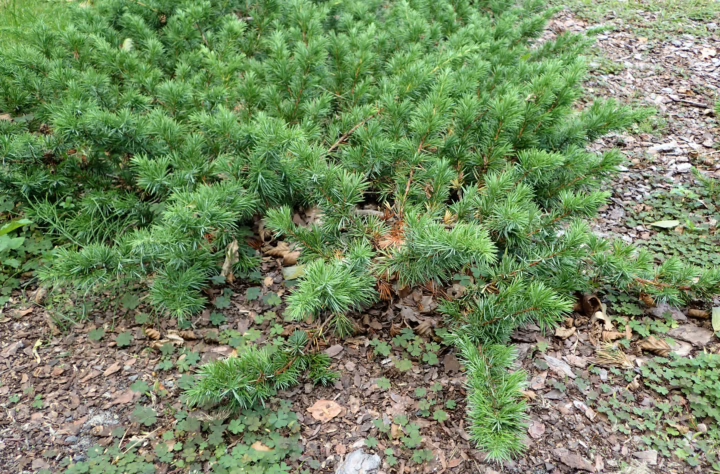
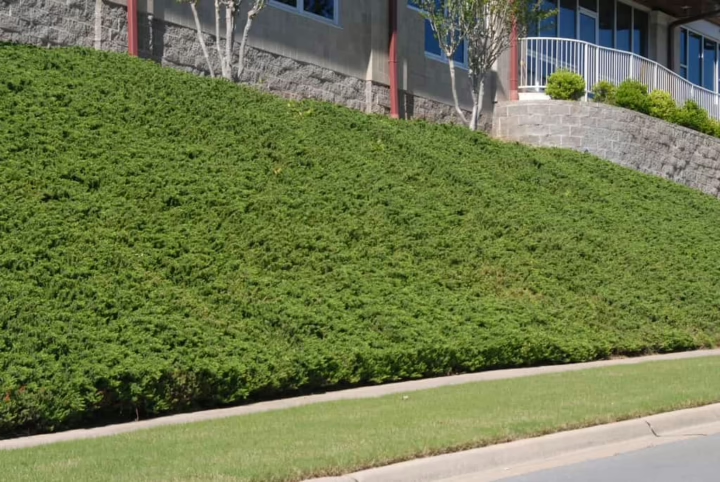
Juniperus conferta
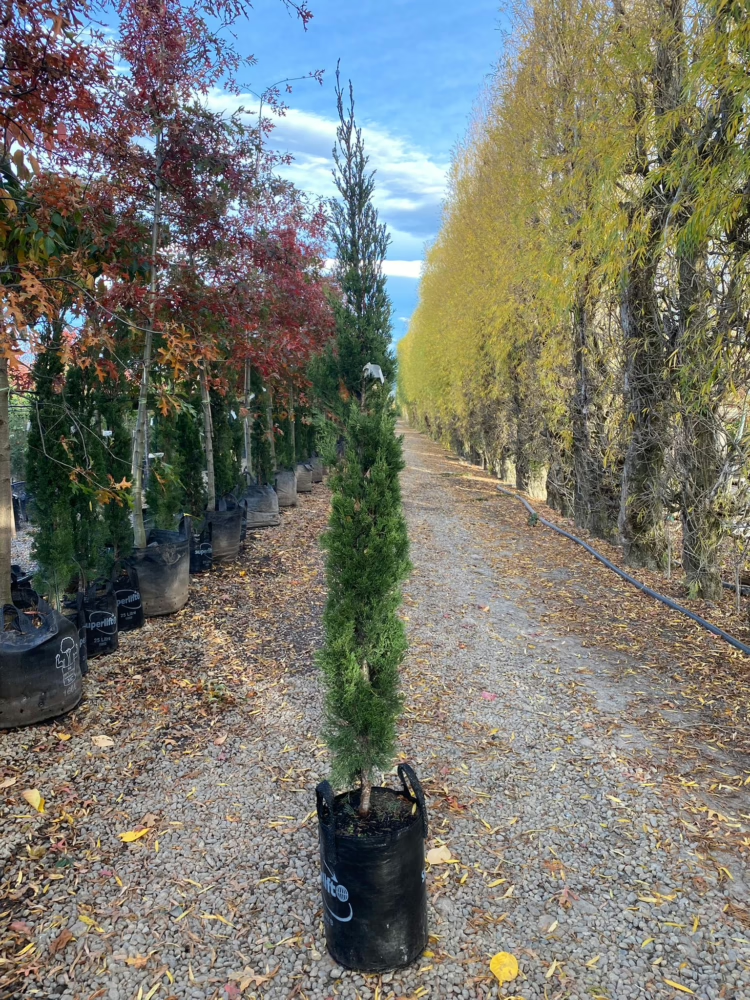
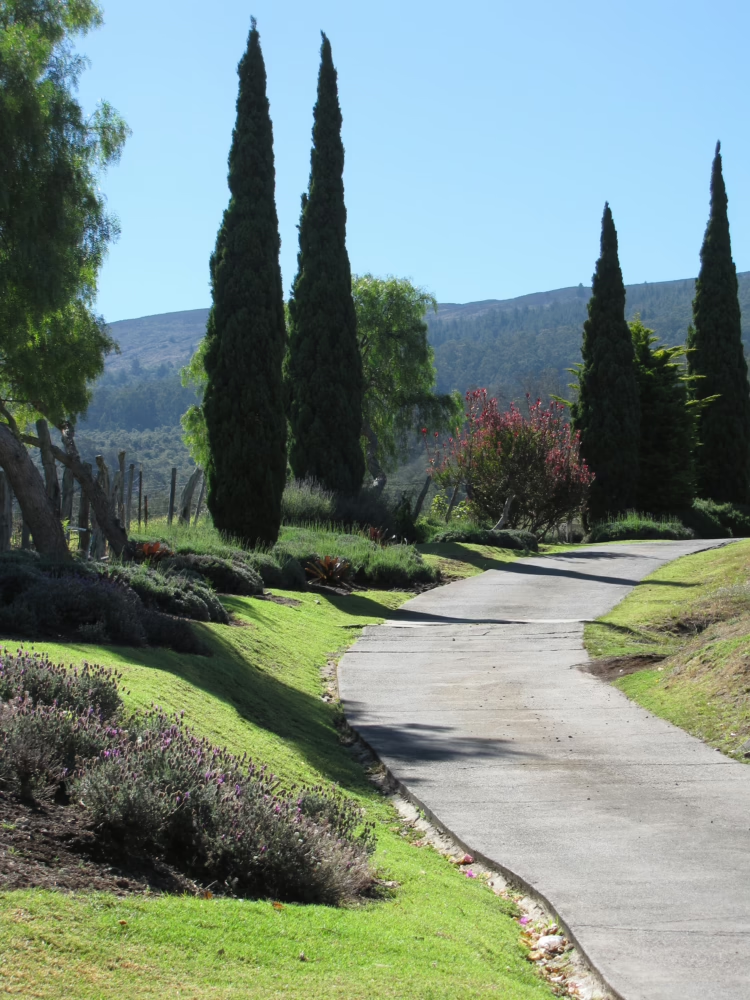
Cupressus sempervirens ‘Green Arrow’
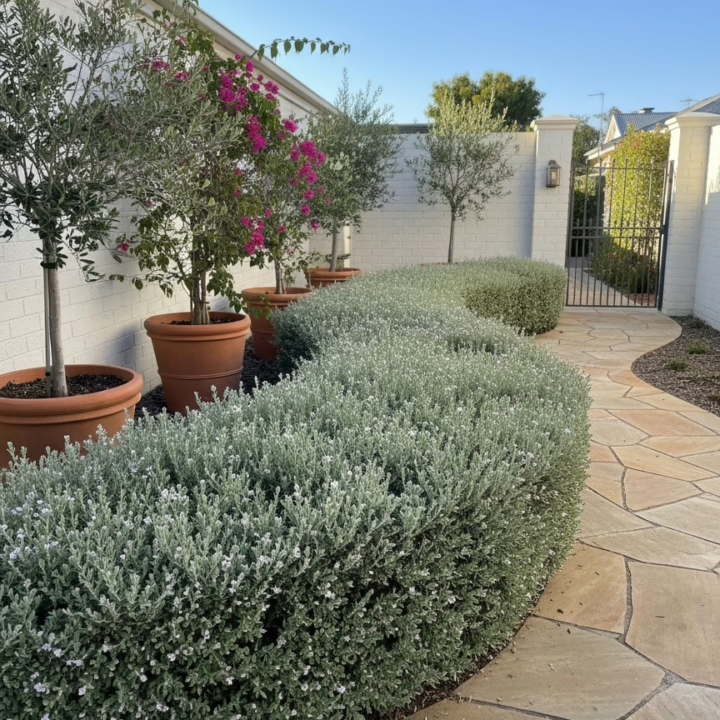
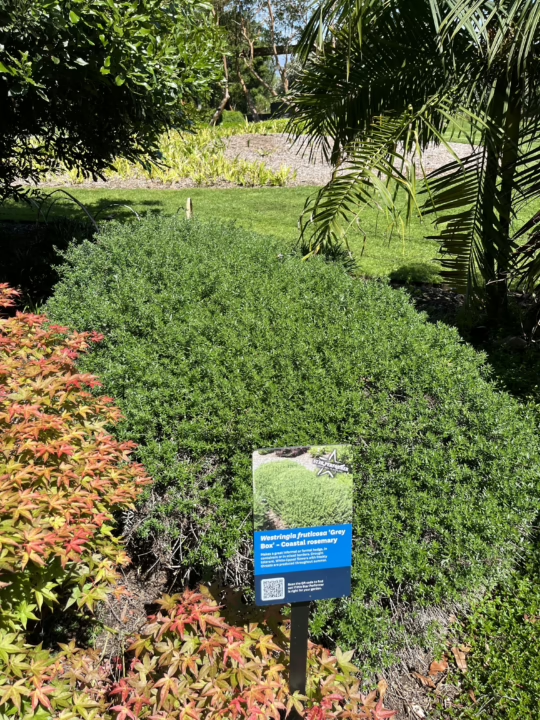
Westringia fruticosa ‘Grey Box’
More information about Erica cerinthoides ()
See below for an explanation of terms.
Summer
Autumn
Winter
Spring
Explanation of terms
This scale provides information on the resilience of species to the projected future climate in New Zealand – using the Auckland Botanic Gardens as the central location for projected future temperatures. This projection is based upon the ‘Business as Usual’ climate change scenario that uses the SSP3 or RCP7.0 emission scenario as laid out by the IPCC. It is a ‘worst case scenario’ and predicts the climate of 2090 — 70 years into the future — assuming that no steps have been taken to curb global emissions. The analysis of climate suitability of species is based on Mean Annual Temperature (MAT). The MAT for the Auckland Botanic Gardens under the ‘Business as Usual’ climate change scenario is projected to be 18.8 °C.
 Highly resilient indicates that the species is mostly found growing within this MAT, meaning that at this MAT the species is expected to be within its preferred temperature range. Bear in mind that the MAT does not necessarily account for extreme weather events, such as heatwaves or frosts/freezes, and droughts. A species’ precipitation needs should be considered as well.
 Resilient indicates that the species does occur at this temperature. It may not be the species’ most preferred climate, but it is anticipated to be well suited to this MAT.
 Limited resilience indicates that there are known occurrences of the species growing at this MAT, but this MAT is near the limit of known occurrences. The species may be able to be grown at this temperature, but care regarding its microclimate, context and vulnerability to other factors such as pests and diseases may be required.
 Not currently recorded indicates that there are no current records of the species growing at this MAT. If there are very few records for a specific species, this may simply be an indication of a lack of recorded observations, and not plant performance.
It is important to note that there are, generally speaking, more records occurring in the Northern Hemisphere and in cooler climates than there are for the Southern Hemisphere and the southern predominance of warmer climates. This can lead to a potential skewing in the data and results may be biased toward colder climates, indicating less heat tolerance than is true of the species.
This information gleaned from the Climate Assessment Tool aims to provide guidance and support for decisions; it is not an absolute answer, and while the predictions are based on rigorous scientific data, they are just that — predictions. The information will give you an idea of what is more likely to suit New Zealand’s future climate, but trialling of plants in the landscape is still a necessity.
Information sourced from the Climate Assessment Tool provided by the Botanic Gardens Conservation International organisation and can be accessed here: https://cat.bgci.org
Healthy crowns differ in their density as a function of leaf and branching characteristics. Three categories are used: dense, moderately dense and open. In some cases, it has been possible to underpin these categories with leaf area index (LAI: leaf area per unit ground area (m2 m-2) data.
 Dense crowns typically have a LAI of >6m2 m-2.
 Moderately dense crowns typically have a LAI of 3-6m2 m-2.
 Open crowns typically have a LAI of <3m2 m-2.
Information sourced from the Tree Species Selection for Green Infrastructure guide produced by the Trees & Design Action Group. Find the guide here: https://www.tdag.org.uk/tree-species-selection-for-green-infrastructure.html
Tree crowns often have a characteristic form when grown in open environments. This feature can often be an important design element of a planting scheme as well as affecting how the tree crown interacts with surrounding vegetation and infrastructure. Despite a tendency for a particular form, very few species rigidly conform to a particular shape. Many species are inherently variable in their morphology as a function of maturity or environment and fall somewhere between categories.
 Globular crowns have a rounded form with vertical and horizontal dimensions being approximately equal.
 Ovoid crowns are somewhat elliptic, broader at the base than they are at the top, with the vertical axis greatly exceeding the horizontal axis.
 Obovoid crowns are also somewhat elliptic, with the vertical axis greatly exceeding the horizontal axis but are broader in the upper part of the crown.
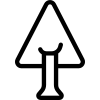 Conical crowns are approximately triangular in their outline and are broadest at their base.
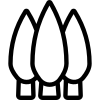 Columnar crowns have a vertical axis that greatly exceeds the horizontal axis but the proportions of the upper and lower crown are similar.
 Irregular crowns have an asymmetrical and uneven outline.
 Weeping crowns have strongly pendulous branches.
 Vase crowns are much broader in the upper crown, which is often relatively flat rather than rounded.
Information sourced from the Tree Species Selection for Green Infrastructure guide produced by the Trees & Design Action Group. Find the guide here: https://www.tdag.org.uk/tree-species-selection-for-green-infrastructure.html
The four-level scale, tolerant, moderately tolerant, moderately sensitive and sensitive, makes use of a number of sources of information (see the guide below for further information on this).
Regardless of a species’ drought tolerance ranking, the full expression of drought tolerance will only come about in well-established trees. Therefore, the selection of drought tolerant trees should never be seen as a substitute for good post-planting aftercare, such as mulching and irrigation.
 Tolerant
 Moderately tolerant
 Moderately sensitive
 Sensitive
Information sourced from the Tree Species Selection for Green Infrastructure guide produced by the Trees & Design Action Group. Find the guide here: https://www.tdag.org.uk/tree-species-selection-for-green-infrastructure.html
 Evergreen plants retain foliage year-round but still shed and replace some leaves gradually as part of their normal growth cycle, rather than losing them all at once.
 Deciduous plants shed all their leaves for part of the year (usually in autumn and winter), usually in response to colder temperatures or dry seasons, often producing seasonal colour before leaf drop.
 Semi-evergreen plants sit between the two, keeping most of their foliage but losing some or all leaves briefly under cooler or drier conditions before quickly regrowing them.
A species is allocated its shade tolerance rating based on whether they can grow satisfactorily at a certain light availability. The four-level scale used relates approximately to the following light conditions, expressed as a percentage of full sunlight.
 Tolerant (<10% full sunlight)
 Moderately tolerant (10-25% full sunlight)
 Partially tolerant (25-50% full sunlight)
 Intolerant (>50% full sunlight)
It should be noted that many species towards the more tolerant end of the spectrum often perform better in slightly higher light levels than their tolerance rating suggests, however, it is generally unrewarding to plant moderately tolerant or tolerant trees in fully open (high-light) environments. It should also be acknowledged that, for many larger species, shade tolerance diminishes somewhat with age. This is because a tree’s need for shade tolerance is typically reduced as it becomes established within the forest canopy. Therefore, the allocated ratings are most closely related to young trees of the species and not fully mature specimens.
Information sourced from the Tree Species Selection for Green Infrastructure guide produced by the Trees & Design Action Group. Find the guide here: https://www.tdag.org.uk/tree-species-selection-for-green-infrastructure.html
When designing and planting your garden, it can be useful to know whether the soil is acid or alkaline, as different plants thrive in different soils. The soil pH is a number that describes how acid or alkaline your soil is. The soil pH scale will give you an idea of what soils a species will grow in.
 Acidic soils have a pH below 7.0
 Alkaline soils have a pH above 7.0
 Neutral soils have a pH of 7.0
 Chalky soil is alkaline and often contains visible pieces of chalk or limestone. It drains very quickly and can be low in nutrients, making it difficult for many plants to grow unless organic matter is added. Some plants, however, thrive in its free-draining, lime-rich conditions.
 Rocky soil contains a high proportion of stones and gravel. It usually drains well but holds very little water or nutrients. Plant roots may struggle to establish, though hardy, drought-tolerant plants can adapt to it.
 Sandy soil has large particles that feel gritty to the touch. It drains quickly and warms up fast in spring, but it does not retain moisture or nutrients well. Regular watering and the addition of compost can improve its fertility.
 Loamy soil is a balanced mix of sand, silt, and clay. It holds moisture and nutrients well while still allowing excess water to drain, making it ideal for most plants. Loam is generally considered the best all-round soil for gardening and agriculture.
 Clay soil is made up of very fine particles and feels smooth or sticky when wet. It retains water and nutrients well but drains poorly and can become compacted. With proper management, such as adding organic matter, clay soil can be very fertile.
Most temperate deciduous trees can cope with several weeks of waterlogging during the period of winter dormancy as metabolic activity is minimal. However, waterlogging during active growth is more serious because roots are more active and require aerobic soils. In general, the more active the growth, the more rapidly the effects of waterlogging can be seen. Factors such as the water oxygenation status and temperature will also affect how acutely waterlogging stress develops so there can be a great deal of variation around how trees experience waterlogging stress.
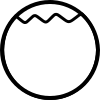 Tolerant species can survive consistent waterlogging for the duration of the growing season.
 Moderately tolerant species can survive consistent waterlogging for approximately one month during the growing season.
 Moderately sensitive species are only likely to survive if the waterlogging event is less than two weeks during the growing season.
 Sensitive species are only likely to survive if the waterlogging event is less than a few days during the growing season.
It is important to note that as this scale relates to the likely time-course to tree mortality, symptoms of waterlogging (and associated dysfunction) will be apparent within a shorter period of time.
Information sourced from the Tree Species Selection for Green Infrastructure guide produced by the Trees & Design Action Group. Find the guide here: https://www.tdag.org.uk/tree-species-selection-for-green-infrastructure.html